


Have you ever walked into a bedroom and felt like something was off? Maybe it felt too tight to move around. Maybe it felt huge but empty. That feeling usually comes down to one thing: square footage. Knowing the average bedroom square footage helps you plan smarter, whether you’re buying a home, building one, or just rearranging your furniture. I’ve spent time measuring rooms, comparing floor plans, and talking to homeowners about what really works. In this guide, I’ll walk you through real numbers, real examples, and simple tips you can use today. No confusing jargon. No guesswork. Just clear answers about bedroom sizes that make sense for real life.
What Is the Average Bedroom Square Footage in the US?
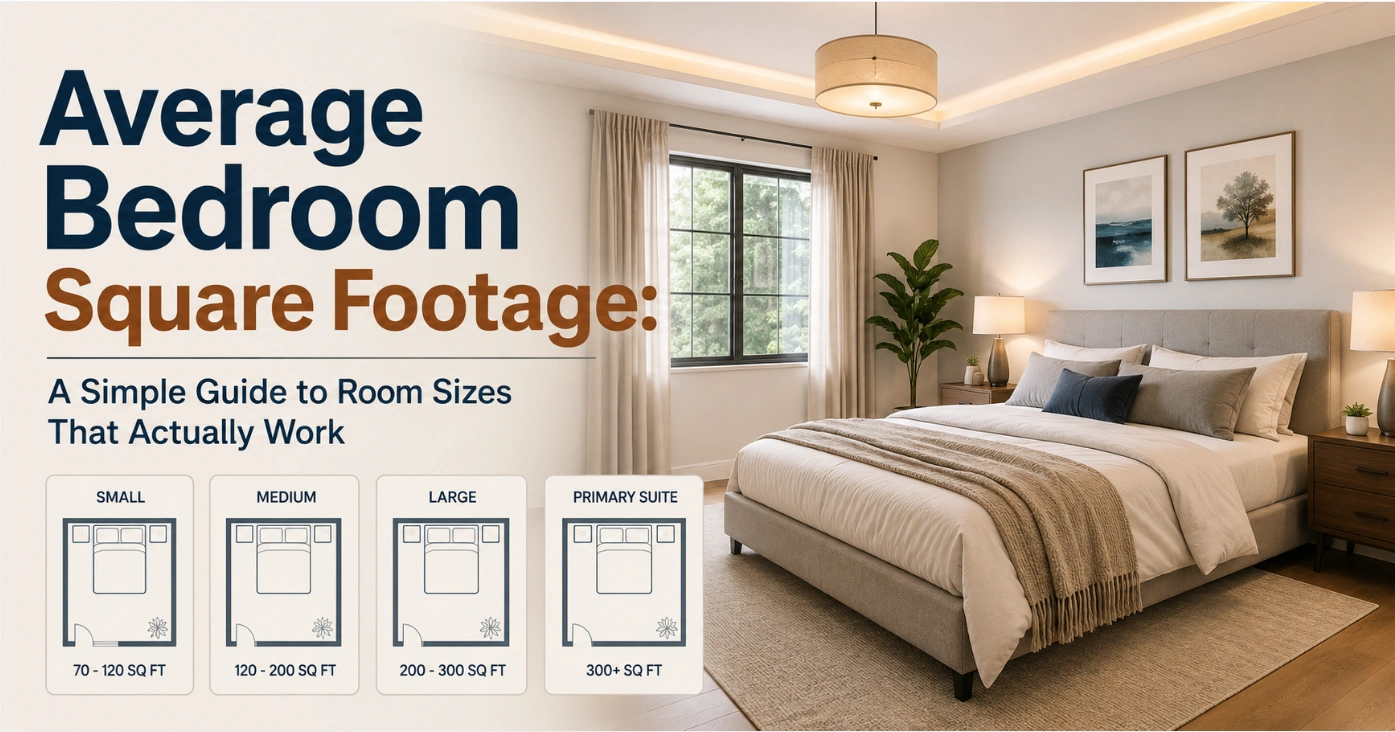
Let’s start with the big number everyone wants to know. The average bedroom size in U.S. homes is 11 feet x 12 feet, which equals 132 square feet. This number blends together master bedrooms, kids’ rooms, and guest rooms across the country. It’s a helpful baseline, but it’s not the whole story. Bedrooms in the U.S. typically range from 120 to 200 square feet, depending on the type of room and the home it sits in. Think of 132 square feet as the middle point on a long ruler. Some rooms fall well below it. Others stretch far above it. When people ask about average bedroom square footage, they’re usually picturing a comfortable space for a bed, a dresser, and a little walking room. That’s exactly what 132 square feet gives you in most cases.
Standard Bedroom Sizes by Room Type
Not every bedroom in a house is built the same way. Builders plan different sizes depending on how a room will be used. The standard size of a secondary bedroom is 10 feet by 12 feet, or 120 square feet, giving enough room for a queen or full bed with some extra furniture. Guest bedrooms usually match that same size, around 120 square feet. Kids’ bedrooms tend to be smaller, often 10 feet by 10 feet, or 100 square feet, since a twin bed needs less floor space. I always tell people to think about furniture first, then size. A room built for a twin bed and a small desk doesn’t need the same dimensions as a room meant for a king bed and a reading chair. Matching the room type to its purpose saves you money and stress later.
| Bedroom Type | Standard Size (Feet) | Square Footage |
|---|---|---|
| Kids’ Bedroom | 10 x 10 | 100 sq ft |
| Secondary/Guest Bedroom | 10 x 12 | 120 sq ft |
| Average Bedroom (Overall) | 11 x 12 | 132 sq ft |
| Master Bedroom | 14 x 16 | 224 sq ft |
| Luxury Master Suite | 20 x 22+ | 440+ sq ft |
Master Bedroom Square Footage Explained
Master bedrooms get special treatment in most home designs, and the numbers prove it. The standard size of a master bedroom is 14 feet by 16 feet, or 224 square feet, which is noticeably larger than any other bedroom in the house. That extra average bedroom square footage gives room for a king-size bed, two nightstands, a dresser, and sometimes even a small sitting area. Common master bedroom dimensions range from 12×14 feet up to 12×16 feet, though many newer homes push well past that. I’ve noticed that builders treat the master bedroom almost like a mini retreat. It’s not just a place to sleep anymore. It’s a private space where homeowners relax, read, or even work. That shift in purpose explains why master bedroom sizes keep climbing in newer construction across the country.
How Home Size Affects Bedroom Square Footage
Here’s something a lot of people don’t realize: your whole house size shapes your bedroom size. Bedrooms typically take up about 10% of a home’s total square footage, so a bigger house almost always means bigger bedrooms. In a 2,000-square-foot home with three bedrooms, each bedroom averages around 200 square feet. That’s larger than the national average bedroom square footage because the whole home has more space to share. On the flip side, standard bedrooms can take up roughly 7% of total home space in some markets, shrinking the numbers down. This is why two houses with the same number of bedrooms can feel completely different. A 3,000-square-foot home and a 1,200-square-foot home both might have three bedrooms, but the rooms themselves won’t feel anything alike. Total square footage really does drive everything else.
Bedroom Sizes by US Region
Where you live changes your bedroom size more than most people expect. Homes in Colorado tend to have the largest bedroom square footage, while homes in Massachusetts tend toward the smallest. This pattern comes down to land costs, building rules, and what local buyers expect. States with newer suburban housing, like Texas, Colorado, and Georgia, tend to have larger primary bedrooms, since there’s more open land to build on. Meanwhile, older housing markets in the Northeast and city centers have more compact bedroom footprints. I find this fascinating because it shows that average bedroom square footage isn’t a fixed number at all. It shifts based on history, geography, and even local construction trends. If you’re house hunting in a big city, expect smaller rooms than you’d find in a brand-new suburban development out west.
| Region/State Type | Bedroom Size Trend | Typical Range |
|---|---|---|
| Older Northeast Homes | Smaller, compact rooms | 80–120 sq ft |
| Urban Apartments/Condos | Smallest, often near code minimum | 70–100 sq ft |
| Suburban New Builds | Larger, generous layouts | 150–224 sq ft |
| Texas, Colorado, Georgia | Largest primary bedrooms | 224–350+ sq ft |
How Home Age Changes Bedroom Square Footage
Old houses and new houses tell very different stories about bedroom size. Older homes built before the 1970s and ’80s tend to have smaller, more uniformly sized bedrooms, and large master suites were less common back then. New builds commonly include one large primary bedroom along with smaller secondary bedrooms, a layout that barely existed decades ago. This explains why your grandparents’ old house might have three bedrooms that are all roughly the same size. Builders back then weren’t thinking about a separate, oversized retreat for parents. Today’s homes do things differently. Traditional styles like raised ranches, Craftsman homes, Victorians, and Colonials often feature smaller bedrooms with only a slightly larger primary bedroom, if one exists at all. So if you’re touring an older home expecting today’s average bedroom square footage, you might be surprised by how cozy the rooms feel.
Minimum Legal Bedroom Size Requirements
Before you can call a room a “bedroom,” it has to meet certain rules. Urban apartments and condos frequently have bedrooms on the smaller end, sometimes just meeting the legal minimum of 70 square feet. Building codes in most US jurisdictions require a minimum of 70 square feet for a room to qualify as a bedroom, with at least 7 feet in any horizontal direction. There are other rules too. A bedroom must have at least two electrical outlets and a heating system capable of keeping it at 68 degrees Fahrenheit or warmer. Bedroom windows must equal at least 8% of the floor area, and at least half of that window space must actually open. These rules exist for safety, not just comfort. A tiny, windowless closet can’t legally be called a bedroom, no matter how someone tries to list it. Knowing these minimums helps you spot a real bedroom versus a room that’s just being stretched to look like one.
The 3:1 Rule for Bedroom Size and Bed Footprint
Want a simple trick for figuring out the right room size? Try the 3:1 rule. This guideline states your bedroom should have roughly three times the square footage of the bed’s footprint. For a queen bed with a 33-square-foot footprint, the ideal room size would be around 99 square feet. That lines up nicely with the standard 10-foot by 10-foot or 10-foot by 12-foot secondary bedroom you’ll find in most homes. I love this rule because it’s so easy to remember. Measure your bed. Multiply by three. That’s roughly the room size you need for comfortable movement. It’s not a strict law, but it’s a smart starting point. If your room falls way below that number, expect a cramped feeling no matter how nice your furniture looks.
How to Calculate Your Own Bedroom Square Footage
Figuring out your bedroom’s exact size only takes a minute, and you don’t need any special tools. Calculating your bedroom’s square footage is straightforward: measure the length and width of your room in feet, then multiply the two numbers together. For example, a room that is 12 feet long and 11 feet wide has a square footage of 132 square feet. Grab a tape measure and check both walls before you trust any listing or floor plan. For rooms that aren’t perfect rectangles, there’s still an easy fix. For L-shaped or irregular rooms, divide the space into rectangles, calculate each section separately, and add them together. This simple math helps you compare your room to the average bedroom square footage we’ve talked about, so you know exactly where your space stands.
Bedroom Size and Mattress Compatibility
Choosing the right mattress for your room size matters more than people think. A queen mattress works well in a standard bedroom of 11 feet by 12 feet or larger, though the room will feel cozier. A full or double mattress fits comfortably in most standard bedrooms, leaving plenty of room for other furniture. Twin and Twin XL mattresses remain the top choice for children’s rooms, since they leave maximum floor space for play. King beds need the most planning. A king-size bed alone occupies over 42 square feet of floor space, so it really only fits well inside a true master bedroom. I always recommend measuring your mattress before buying one for a smaller room. A bed that’s too big for the space can make even a decent-sized bedroom feel cramped and hard to walk through.
Small Bedroom Design Tips That Actually Work
Living with a smaller-than-average bedroom doesn’t mean giving up on comfort. In smaller bedrooms, the bed takes up the most amount of space, so choosing a bed with built-in storage underneath helps maximize the room. Positioning most of the furniture along one wall keeps the rest of the floor open, which makes a small room feel less crowded right away. Using vertical space, like a tall wardrobe instead of a wide dresser, frees up valuable floor area too. I’ve seen tiny rooms transform just by swapping bulky furniture for taller, narrower pieces. It’s a small change that makes a big visual difference. Mirrors help too, since they bounce light around and trick the eye into seeing more space than there actually is. You don’t need extra square footage to feel comfortable. You just need smarter choices.
Bedroom Square Footage and Home Value
Bedroom size doesn’t just affect comfort. It affects what your home is worth. Bedroom size directly influences a home’s marketability and appraised value, and buyers consistently rank a spacious master suite among the most desirable features. Rooms that meet or exceed standard dimensions for their type tend to appraise higher than undersized alternatives. This matters a lot if you’re planning to sell someday. A room that falls below the legal minimum of 70 square feet or lacks a proper window cannot even be counted as a bedroom on an appraisal or listing. That means a tiny den you call a “bedroom” might not add value the way you expect. If you’re remodeling, pushing a room up to standard average bedroom square footage, even by a little, can pay off when it’s time to sell.
Average Bedroom Square Footage by Mattress Size
Sometimes it helps to see numbers side by side. This table breaks down which mattress sizes fit comfortably into which bedroom dimensions, based on common industry guidance.
| Mattress Size | Mattress Footprint | Minimum Comfortable Room Size |
|---|---|---|
| Twin/Twin XL | ~20 sq ft | 70–80 sq ft |
| Full/Double | ~28 sq ft | 100–120 sq ft |
| Queen | ~33 sq ft | 100–132 sq ft |
| King | ~42 sq ft | 150–224 sq ft |
Common Mistakes People Make With Bedroom Sizing
After looking at dozens of floor plans, I keep seeing the same mistakes pop up. People buy a king bed for a room that’s barely 100 square feet, then wonder why it feels like an obstacle course. Others assume bigger is always better, filling a huge master bedroom with furniture it doesn’t need, which makes it feel cluttered instead of grand. Another common slip-up is ignoring walking space around the bed. A room can technically fit a bed and still feel unusable if there’s no clearance to open drawers or walk past comfortably. The fix is simple: always measure first, then shop for furniture. Don’t fall in love with a bed or dresser before confirming it actually fits your average bedroom square footage with room to spare.
Final Thoughts: Finding the Right Bedroom Size for You
At the end of the day, average bedroom square footage is just a starting point, not a rulebook you have to follow exactly. Whether your room is 100 square feet or 300, what matters most is how it works for your life. Measure your space, think about your furniture, and don’t be afraid to get creative with smaller rooms. A well-planned space almost always beats a bigger one that’s poorly arranged. If you’re house hunting, building, or remodeling, use these numbers as your guide, not your limit. Take a tape measure to your current bedroom today and see how it compares. You might be surprised by what you find, and that knowledge puts you in control of your next decision.
Frequently Asked Questions
What is the average bedroom square footage in a typical US home?
The average bedroom square footage across the US sits around 132 square feet, which works out to roughly 11 feet by 12 feet. This number combines master bedrooms, kids’ rooms, and guest rooms together, so individual rooms can be smaller or larger depending on their purpose.
How big is the average master bedroom?
The average master bedroom measures about 224 square feet, or 14 feet by 16 feet. This larger average bedroom square footage gives enough room for a king-size bed, two nightstands, and a dresser, with space left over for walking comfortably around the furniture.
What is the smallest legal bedroom size?
Most areas in the US require a minimum of 70 square feet for a room to legally count as a bedroom. The room also needs proper windows, electrical outlets, and heating to meet code, so size alone isn’t the only requirement that matters.
Does home age affect average bedroom square footage?
Yes, home age makes a big difference. Older homes built before the 1970s tend to have smaller, more evenly sized bedrooms throughout the house. Newer homes usually feature one larger primary bedroom paired with smaller secondary bedrooms for kids or guests.
How do I measure my bedroom’s square footage?
Measure the length and width of your room in feet using a tape measure, then multiply those two numbers together. For irregular or L-shaped rooms, split the space into smaller rectangles, calculate each one separately, and add the totals together for your final number.
Why does bedroom square footage matter for home value?
Bedroom size affects how much buyers are willing to pay for a home. Rooms that meet standard average bedroom square footage tend to appraise higher than undersized rooms. A room below the legal minimum size can’t even be officially counted as a bedroom on paper.
