


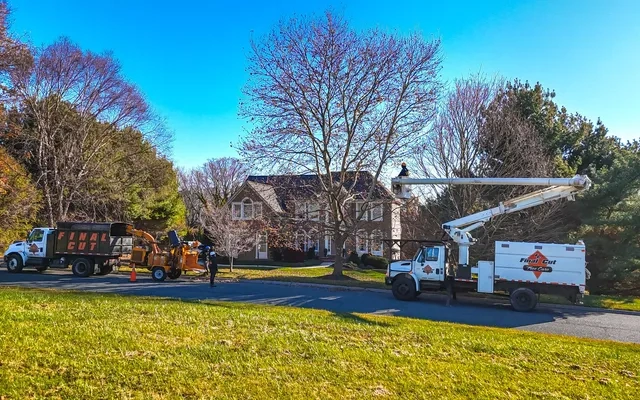
Most homeowners only think about their trees when something looks wrong. A branch starts hanging over the roof, a trunk develops a worrying lean, or a once full canopy begins to thin out. The natural next question is whether the tree needs a trim or whether it has to come out entirely. It is an important decision, because trimming a tree that should be removed leaves a hazard standing, while removing a tree that could have been saved throws away years of growth and shade you cannot get back quickly.
The right answer depends on the tree’s health, its structure, and where it sits on your property. This guide breaks down when trimming is the smart move, when removal is the safer choice, and how to tell the difference before you call anyone.
What Tree Trimming Actually Does
Trimming, also called pruning, is maintenance. It keeps a healthy tree healthy and a manageable tree manageable. Done well, pruning removes dead or diseased branches, improves the tree’s structure, increases airflow through the canopy, and reduces the weight and wind resistance that make limbs fail in a storm.
Trimming is the right call when the tree is fundamentally sound. If the trunk is solid, the roots are stable, and most of the canopy is alive and healthy, then the problems you are seeing, such as a few dead limbs, branches rubbing the house, or an overgrown crown, are maintenance issues. Regular, correct pruning can keep that tree safe and attractive for decades.
For anything beyond minor shaping, this is work worth handing to a trained crew. Heavy or structural cuts on a large tree are easy to get wrong, and bad pruning can do real long term harm. A company like Panorama Tree Care in Tampa handles both trimming and removal, which means they can prune what should be saved and only recommend taking a tree out when it genuinely needs to go, rather than defaulting to the bigger job.
When Removal Is the Safer Choice
Sometimes a tree is past the point where pruning helps, and trying to save it only delays a problem that is going to get worse and more dangerous. Removal is usually the right decision when one or more of these is true:
- The trunk has large cavities, deep cracks, or extensive decay that compromise its structure.
- The tree is dead or more than about half dead, with a canopy that will not recover.
- There is a sudden lean combined with soil heaving or lifting at the base, which signals root failure.
- Major roots have been cut or are badly rotted, leaving the tree poorly anchored.
- The tree is simply too close to the house, foundation, or power lines to be safe, regardless of its health.
A single one of these does not always mean automatic removal, but several together usually do. The key question is not whether the tree is beautiful or sentimental, but whether it can be made safe. If it cannot, removal protects everything around it.
The Gray Area: When It Could Go Either Way
Plenty of trees fall somewhere in the middle, and this is exactly where a professional opinion earns its cost. A tree with a moderate cavity, some deadwood, and a slight lean might be a strong candidate for preservation through pruning, cabling, or bracing. The same tree, if the decay is more advanced than it looks from the outside, might be a removal.
The difference often comes down to things you cannot see from the ground, such as the true extent of internal decay or the real condition of the root system. This is why a documented assessment from a qualified arborist is worth more than a guess. They can tell you not just what the tree looks like today, but how it is likely to behave in the next storm.
Why This Decision Matters More in Florida
In a state like Florida, the stakes are higher than in much of the country. Hurricane season runs from June through November, and a marginal tree that might survive for years in a calm climate can become a serious liability the first time a tropical system passes through. Sandy soils that drain fast but anchor poorly make root failure more common, and large oaks and palms often grow close to homes.
There is also a legal layer. Many Florida cities and counties protect trees by size or species, and removing certain trees without the proper permit can result in significant fines. A good local crew knows these rules, pulls the required permits, and handles the paperwork, which keeps your project both safe and compliant.
How to Make the Call Before You Hire
Before scheduling any work, walk your property and look honestly at each tree in question. Check the trunk for cracks, cavities, and soft or decayed wood. Look up at the canopy for large dead limbs and overall thinning. Examine the base for heaving soil, exposed or cut roots, and fungal growth. Note how close the tree is to your house, driveway, and any power lines.
If the tree is basically healthy with maintenance level issues, trimming is very likely the answer. If you are seeing structural failure, advanced decay, or a tree that is dangerously placed, removal is probably the safer path. When it is not clear, which is often, bring in a certified arborist for an assessment rather than guessing, especially before storm season.
The Bottom Line
Trimming and removal solve different problems. Pruning preserves and protects a tree that is fundamentally sound, while removal eliminates a hazard that cannot be made safe. Look closely at the trunk, canopy, roots, and location, weigh how the tree is likely to hold up in a storm, and lean on a qualified professional for the cases in between. Making the right call protects your property, your budget, and the trees that are genuinely worth keeping.
