


Introduction
When people hear 100 square feet, they often wonder what that space actually looks like. Is it big or small? Can you live in it? Or is it only good for storage? These are common questions. Many people search online for answers when planning a small room, office, or studio.
Understanding 100 square feet becomes easier when we compare it to real spaces. A small bedroom, a storage unit, or a compact office can be close to this size. But numbers alone can feel confusing. That is why we also talk about shapes, measurements, and everyday examples.
You may also see people asking about conversions like 100 square meters to square feet or 100 m to square feet. These conversions help people compare measurements used in different countries. Once you understand the basics, it becomes simple to picture the size.
In this guide, we will explore 100 square feet in detail. You will learn how big it is, how to convert it, and what you can fit inside it. We will also look at practical examples so the space becomes easier to imagine.
What Does 100 Square Feet Mean?
The term 100 square feet describes an area that covers 100 square feet of floor space. It does not tell you the shape. Instead, it tells you the total area.
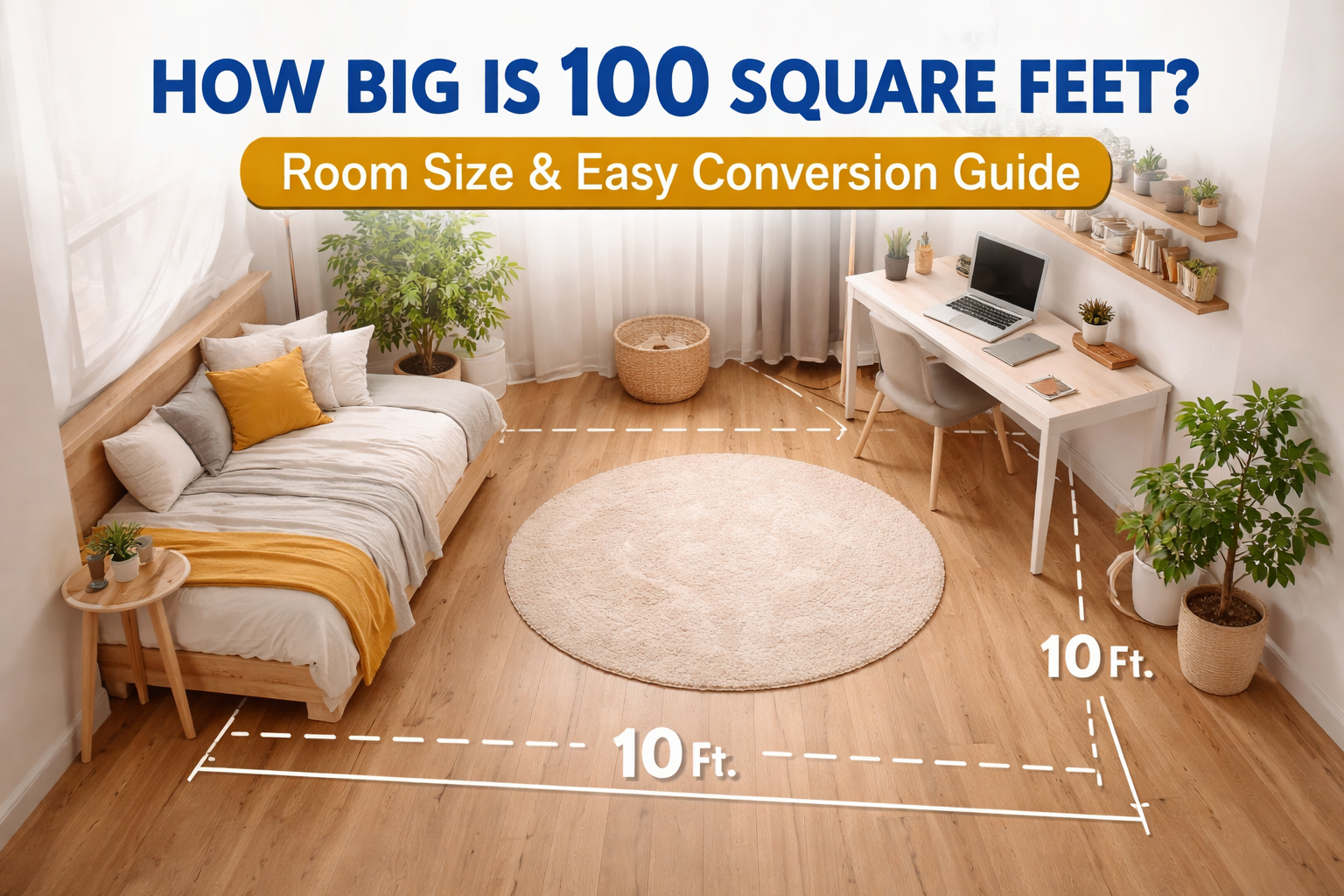
The easiest way to imagine this space is a 10-foot by 10-foot square. Multiply 10 by 10, and you get 100. But that is not the only possible shape. The same area could also be:
- 5 feet by 20 feet
- 4 feet by 25 feet
- 8 feet by 12.5 feet
All of these shapes equal 100 square feet. The total space stays the same even though the layout changes.
People often compare this size to a small bedroom, a large walk-in closet, or a tiny office. It is not huge, but it can still be useful with smart planning.
If you are designing a 100 square feet room, the layout matters more than the number itself. Furniture placement and storage can make the space feel larger than it really is.
How Big Is 100 Square Feet?
Many people ask, how big is 100 square feet because numbers alone are hard to picture. The size becomes clearer when we compare it to everyday things.
Imagine laying out a square area that is 10 feet wide and 10 feet long. That equals 100 square feet. It is roughly the size of a small bedroom or a large storage unit.
To make it easier to imagine:
- It can fit a small bed and a desk.
- It could work as a tiny home office.
- It may hold a compact seating area.
But the space can feel crowded if you add too much furniture. That is why careful planning is important.
Another way to understand how large is 100 square feet is to compare it to parking spaces. Many parking spots are slightly larger than this. So the area is about the size of a small car space.
Once you visualize it this way, the measurement becomes easier to understand.
How Large Is 100 Square Feet Compared to Rooms?
A 100 square feet room is considered small by modern home standards. However, it is still usable and practical for many purposes.
For example, a typical bedroom in many homes ranges between 120 and 200 square feet. That means a 100 square feet room is smaller than average but still workable.
Here are common uses for a space of this size:
- Small bedroom
- Home office
- Storage room
- Walk-in closet
- Compact studio workspace
In small apartments or urban homes, spaces like these are common. Many people also convert 100 square feet areas into creative spaces like art studios or reading corners.
Good design makes a huge difference. Light colors, mirrors, and multi-purpose furniture can make the room feel bigger.
Even though it is small, the right layout can turn 100 square feet into a comfortable and efficient space.
100 Square Feet Room Layout Ideas
Designing a 100 square feet room can be fun and creative. The key is to use space wisely. Every inch matters in a small area.
Start with simple furniture. Choose pieces that serve more than one purpose. For example:
- A bed with storage drawers
- A folding desk
- A wall-mounted shelf
Vertical storage is very helpful in small rooms. Shelves and hooks keep the floor clear. This makes the room feel larger.
Lighting also changes how the space feels. Natural light makes 100 square feet appear more open. Mirrors can also reflect light and create the illusion of more space.
Minimalism works best here. Too many items will make the room feel crowded. Instead, keep only essential furniture.
With the right planning, a 100 square feet room can be cozy, stylish, and very functional.
Converting 100 Square Meters to Square Feet
Many people search for 100 square meters to square feet when comparing international measurements.
The conversion is simple:
1 square meter = 10.764 square feet
So if we convert 100 square meters to square feet, the result is:
100 square meters = 1,076.39 square feet
This space is much larger than 100 square feet. In fact, it is more than ten times bigger.
A 100 square meter home could include multiple rooms such as:
- Living room
- Kitchen
- Two bedrooms
- Bathroom
Understanding this difference helps avoid confusion. The numbers may look similar, but the sizes are very different.
100 Square Meters to Feet Explained Simply
Sometimes people write 100 square meters to feet, which can be confusing. Technically, square meters convert to square feet, not just feet.
When converting 100 square meters feet, we are really talking about area measurement.
The correct conversion again is:
100 square meters = about 1,076 square feet
This is roughly the size of a small apartment or a medium house floor plan.
When comparing this with 100 square feet, you can see the difference clearly. One is a small room. The other is a full living space.
Understanding units helps avoid mistakes in planning rooms, buildings, or property sizes.
100 M to Square Feet Conversion
People also search for 100 m to square feet, but this phrase can mean two different things.
If someone means 100 meters in length, that converts differently than area. But when discussing floor space, they usually mean 100 square meters.
Using the correct formula:
100 m² = 1,076.39 square feet
This conversion is useful for property listings and building plans. Many countries use meters instead of feet.
When buyers compare homes internationally, conversions like 100 m to square feet help them understand the actual size.
Knowing both systems makes it easier to read property listings and floor plans.
Real-Life Examples of 100 Square Feet Spaces
Real examples make 100 square feet easier to understand.
Here are some common spaces around this size:
Small bedroom:
A tiny bedroom in older homes may measure about 100 square feet.
Home office:
Many work-from-home setups fit easily in this area.
Storage unit:
Some storage facilities offer units close to this size.
Garden shed:
A large backyard shed may also measure around 100 square feet.
These examples show how flexible this size can be. Even though it is small, it still has many uses.
Tips to Make 100 Square Feet Feel Bigger
A small room can feel larger with smart design choices. This is very helpful when working with 100 square feet.
Here are simple tricks that designers often use:
Use light colors
White or soft colors reflect light and open up the room.
Add mirrors
Mirrors create the illusion of extra space.
Choose multi-purpose furniture
A sofa bed or folding desk saves valuable room.
Keep the floor clear
Wall shelves provide storage without using floor space.
Use vertical storage
Tall shelves make use of wall height.
These small changes can transform a 100 square feet room into a comfortable space.
Is 100 Square Feet Enough to Live In?
Living in 100 square feet is possible, but it requires smart design. Tiny homes and micro-apartments often use this concept.
In very small living spaces, people use:
- Foldable beds
- Compact kitchens
- Hidden storage
- Wall desks
Some minimalist lifestyles even embrace these tiny spaces. However, most full homes are much larger.
A comfortable apartment usually starts around 400–600 square feet.
Still, 100 square feet can work as a sleeping space, office, or studio.
It depends on your needs and how efficiently you use the space.
Common Mistakes When Planning Small Spaces
When designing a 100 square feet room, people often make simple mistakes.
The biggest mistake is adding too much furniture. Large items can quickly fill the room.
Another mistake is ignoring vertical space. Walls provide valuable storage opportunities.
Poor lighting can also make the room feel smaller. Natural light helps open the space visually.
Finally, clutter is the biggest enemy of small rooms. Keeping the space organized makes a huge difference.
Avoiding these mistakes helps you get the most out of 100 square feet.
Frequently Asked Questions
1. How big is 100 square feet in simple terms?
100 square feet is about a 10 ft by 10 ft square. It is similar to a small bedroom or office.
2. How large is 100 square feet compared to a bedroom?
Most bedrooms are 120–200 square feet, so 100 square feet is slightly smaller than average.
3. What can fit in a 100 square feet room?
You can fit a bed, small desk, and chair. Smart storage helps maximize the space.
4. What is 100 square meters to square feet?
100 square meters equals about 1,076 square feet, which is much larger than 100 square feet.
5. Is 100 square feet enough for an office?
Yes. Many home offices comfortably fit within 100 square feet.
6. How do you calculate 100 square feet?
Multiply length × width. For example, 10 ft × 10 ft = 100 square feet.
Conclusion
Understanding 100 square feet becomes much easier when you see real examples and simple comparisons. While it may sound small at first, this space can still be very useful. A small bedroom, compact office, or creative studio can all fit inside 100 square feet with the right design.
Conversions also help when comparing measurements. For example, 100 square meters to square feet equals about 1,076 square feet, which shows a huge difference in size. Knowing these conversions prevents confusion when reading property listings or building plans.
Even though 100 square feet is a compact area, smart planning makes it functional. Minimal furniture, vertical storage, and good lighting can transform the space completely.
Whether you are designing a room, planning storage, or comparing measurements, understanding 100 square feet gives you a clear picture of what that space can really offer.
